This blog is for my Marketing Concepts class. I will post weekly throughout the semester.
Thursday, March 23, 2017
Sunday, March 12, 2017
Week 8- Mind Map and Smart Projects
Week 8
Smart Project and Mind Maps
This week was focused on our Smart Projects. On Tuesday, each group met with Professor Spotts to discuss our projects. We discussed our surveys and also our value proposition canvas. We were provided with some helpful direction that will help us to improve and continue our project. We received direct help on how to organize our surveys and also what kind of questions to add in. We also learned that some of our questions were unnecessary and we had to remove them. On Tuesday we also received a binder with all of our old mind maps in it along with a grade for this half of the semester. We were assigned to create a large mind map for the entire semester thus far over break. I will need to include aspects of everything we have covered and link them together into one large mind map. We also met with our marketing consultant this week. She helped us to fine tune our logo and gave us guidance in other areas as well.Thursday
Friday, March 3, 2017
Week 7- Gato Cafe and the Value Proposition Canvas
Week 7
Gato Cafe
This week we talked about the Shark Tank episode on Gato Cafe. Gato Cafe is a business that wants to open store that serves coffee and prepackaged foods and also has cats around the store. The idea is that people enjoy cats and they would be able to relax and reduce stress by coming to this cafe with cats in it. They did not get a deal with any of the sharks and they do not own a store yet. I think this could be a good idea but I think it would struggle to have a large enough market. As we have learned in many chapters, it is essential to have a large target market and know that market. I do not think there would be enough people that would go out of their way to pay extra money for this Gato Cafe rather than just buying their coffee elsewhere. I think families with children would be their many target market. Kids would love to come to this cafe and their parents could bring them occasionally instead of buying a cat for their house. An example of a Gato Cafe can be found above.Value Proposition Canvas
We also discussed what is called the value proposition canvas, in class this week. The value proposition canvas helps evaluate a product and see what it has to offer. It is meant to help us understand the gap found between product and customer and also between customer and your substitutes, or competitors. The value proposition canvas can be seen on the left. It helps to lay out the benefits, features, and experience of the product. It also shows us what the customer would want, fear, and need from this product. Lastly, it helps us to see who are competitors are, or substitutes.Value Proposition Canvas for Gato Cafe
In class we also completed a value proposition canvas for Gato Cafe. It goes as follows:Product
Benefits: Stress relief, solves issue of hunger or thirst, social gathering
Features: Food, drinks, cats
Experience: Relaxing with cats enjoying a drink or snack
Costumer
Wants: Relaxation, place to bring children who want a cat, stress relief, the experience, food or drink
Needs: Possibly emotion help or therapy
Fears: Allergies, sanitation, aggression in cats
Substitutes
Zoos, coffee shops, pet shops, relaxing places such as spas or resorts.
Conclusion
From this we can gather a lot about Gato Cafe. We understand that there may be fears from customers that we need to address in order to limit these fears. We also would need to make ourselves stand out from any competition such as pet stores or other coffee shops. It can also help us to focus on our benefits and features and make sure we do the most we can with those benefits to create the best product.
Smart Project
We can also use the value proposition canvas to help us with our Smart Projects. This would be very helpful for us to visualize our benefits and features. It would also allow us to think as the customer and think of what fears they may have and want they would want or need from this product. We could also better understand our competitors and how to stand out from them and make our product our own.Sunday, February 26, 2017
Week 6- Chapter 10 and Phone Soap
Week 6
Chapter 10
Chapter 10 is about Product Concepts. A product is everything, both favorable and unfavorable, that a person receives in an exchange. Products can be either business or consumer products. As mentioned in Chapter 7, a business product is used to manufacture other goods or services. An essential part of a product's success is branding. Branding is about separating your product from other companies, and creating your own image in their minds. A products success depends largely on the businesses ability to distinguish their product from others in the eyes of the consumers. When a business gains exclusive rights to a brand or part of a brand, that is called trademark. Another essential part of a successful product is packaging. Packaging does not only serve the purpose of holding the product. It also creates an image of that product in the consumer's mind. For example, every one knows what a can of Pringles looks like.
Phone Soap
We watched the Shark Tank episode on PhoneSoap this week in class. PhoneSoap is a product that cleans and charges your phone. This product is solving the issue of dirty phones. Our phones are a lot dirtier than a public toilet, in fact. However, some of the sharks argued that the target market in this case was too small. They argued that not enough people would spend the money or take the time to clean their phones. It was also discussed whether the product would be sold to consumers or to businesses. Examples of businesses this could be sold to are hospitals, schools, or offices. It could also be sold to the everyday consumer for homes. It is important for PhoneSoap to establish their best market and focus on making sure their product to best fit for that target market.Saturday, February 18, 2017
Week 5- Smart Projects and Chapter 9
Week 5
Smart Projects
This week we did a lot of work on our Smart Projects. My team met on Sunday of last week. In this meeting we pooled our concept solutions together and created our top three solutions. We also revised our point of view statement during this meeting. I felt that we were very efficient during our meeting this week. We plan to meet again this coming Monday. An aspect of our reading that correlates heavily to our smart projects are target markets, which are discussed in Chapter 8. Knowing our target market was a vital part of establishing our point of view statement. It was also essential to create valuable concept solutions. Knowing our market is essential because it will allows us to create out product in a way that is most appealing to our largest market. Thursday we had a joint class with our team members. During this class we did a gallery walk of our updated point of view statements and of our three concept solutions. We received a lot of helpful feedback. I also feel like being able to walk around and view the other groups work was helpful to see how our work compares. Another aspect of our readings that applies here is the idea of knowing your competition.Chapter 9
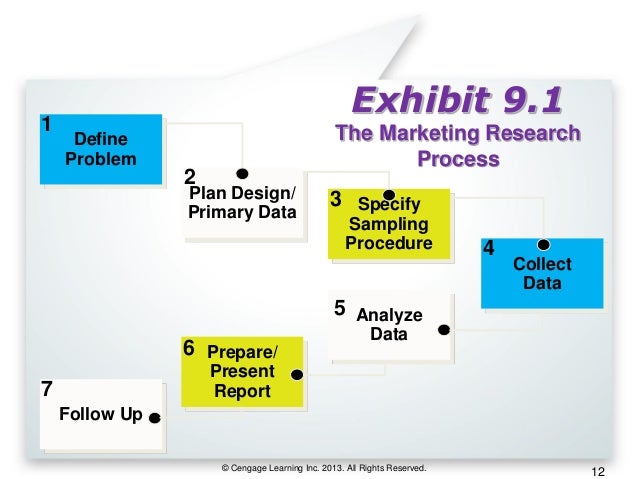
Chapter 9 is the assigned reading for this week. Chapter 9 is all about marketing research. Marketing research is the process of planning, collecting, and analyzing data relevant to a marketing decision. An essential aspect of marketing research is understanding that the marketplace is ever changing and it is important to keep up. The marketing research process is a seven step process. It is shown on the right. In short, the process includes defining a problem, collecting data, analyzing that data, and creating a report to solve the problem. Sometimes it is not even necessary to complete market research. At times it can be a waste of money if you will not gather any valuable information. For example, if a company is already very knowledgeable about their market and their customer's behaviors, then it would not be worth the money for them to conduct market research.The World Around Us
Chapter 9 and our smart projects continue to teach me things about the world around me. Reading about market research makes me realize how many times I have been apart of a company's market research and not even known it. Every survey I have taken has been some form of data collection from a company. Once you learn about why the companies do this research and how the conduct it you look at these surveys and such in a different light. There is more value to them now because they now have a meaning that they lacked in my mind before this reading. Our smart projects continue to teach me how complex and difficult every product on the market is. The amount of effort that goes into creating a product was something I never could have understood without trying it first hand. It is a very complex and in depth process that requires a lot of time and effort.
Friday, February 10, 2017
Week 4- Chapter 8 & Bambooee
Chapter 8
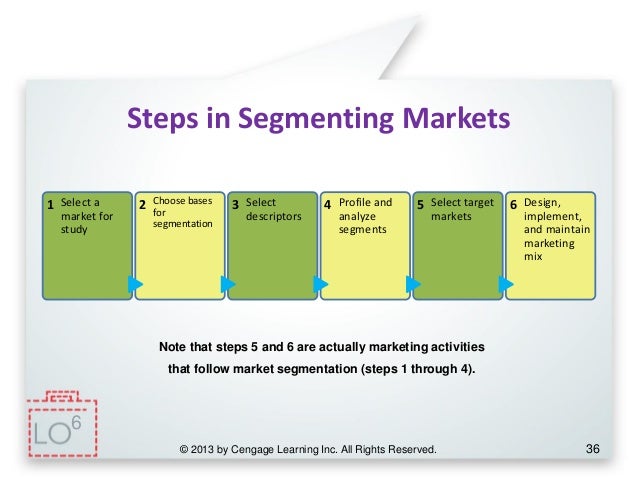
This week, our assigned reading was chapter 8. Chapter 8 is about Segmentation and target markets. Market segment is a subgroup of people or organizations sharing one or more characteristics that cause them to have similar product needs. Segmentation is the process of dividing the market into similar groups that can be distinguished between. Marketers use segmentation bases, which are also known as variables, to divide markets into different segments. Some different segments include geographical, demographic, gender, income, ethnic, and family life cycle. There are six steps in segmenting a market. These steps can be found in the image on the right. The purpose of segmenting markets is to identify marketing opportunities. Positioning is the process of developing a specific marketing mix to influence the potential customers' overall perception of the brand.Bambooee
This week we also watched the shark tank clip on Bambooee. Bambooee is made from an organic bamboo source. It is a towel that is more effective and easier to use than traditional paper towels. They are also machine washable and can be used up to 100 times. This can save a lot of paper and money over time. So, this is beneficial to the consumer and to the environment. On shark tank, one of the sharks agreed to give the company an investment for this product. We were assigned a group in class that we were to create a print ad for. Each group had different incomes and lifestyle habits. My group was number 23, township travelers. Township Travelers exhibit a blend of behaviors representative of their upscale incomes and small town environment. They enjoy outdoor activities like fishing and off-road biking but they also enjoy the indoor comforts of reading, watching college basketball, and shopping at wholesale clubs and gourmet groceries. They are also likely to own a GMC, and follow college baseball. This group is not featured in Western New England's zip code, or the zip code of my hometown. I made my print ad based around this group. I incorporated the outdoors because I felt it was a major part of their group. I also mentioned college baseball, along with the stores they often shop at. I felt that if this ad was meant for them, it would certainly grab their attention and make them more likely to purchase the product. Smart Project
We did not have a joint meeting for our smart projects this week in class. However, Chapter 8 can help us with our projects. It will be important for us to identify our target market in order to create the best product for that target market. We will need to think about the different market segmentations and decide what group of people we will be trying to sell our product to. Our group has planned another meeting this week in which we will continue our concept solutions that we have been working and and begin to narrow it down to our top three.
Sunday, February 5, 2017
Week 3- Chapter 6 and Smart Projects
This week, we were assigned to read Chapter 6. Chapter 6 is about consumer decision making. For managers to understand how consumers make decisions, they must understand consumer behavior. Consumer behavior is defined in our book as "a process a consumer uses to make purchase decisions, as well as to use and dispose of purchased goods or services; also includes factors that influence purchase decisions and product use." Understanding these behaviors is crucial for marketing managers. It helps them to know what the people want to buy, and adjust their products accordingly to meet their criteria. Value, which is a personal assessment of how much an item is worth to you, is a major part of consumer decision making. There are three types of value. Perceived value, utilitarian value, and hedonic value. Perceived is the value the consumer expects to receive, utilitarian is a value derived from a product or service that helps the consumer accomplish tasks (a washing machine). Hedonic value is a value that brings us a good or happy feeling. The consumer decision making process goes as shown below.
We were given a matrix of consumer buying decisions, I will now identify a product one might buy in each cell of the matrix. Limited decision making could include something like toothpaste. It typically occurs when a consumer has previous product experience, but does not know all of the current brands available. So, you may go to buy your normal toothpaste and its out of stock, a consumer will not spend long selecting another similar toothpaste due to the fact that they have experience with the product. Extensive decision making, on the other hand, takes much longer. This typically occurs when buying an expensive product that is unfamiliar and not frequently bought by the consumer. An example would be a home or a car. Routine response behavior occurs when a consumer is buying a low cost good that they spend little time on. One example could be orange juice, milk, or eggs. Brand loyalty occurs when a lot of time and effort is put into the search and decision of which to buy, but then the same brand is bought after that each time. An example for this could be sports clothing, if you are loyal to solely Nike or Adidas.
This week we also had a joint meeting with our team members from the engineering program. In class we went through some activities that helped us to enhance our problem definitions and pov statements. We went around the room in a gallery walk style and left two notes on each of the other teams boards. This helped everyone to improve our ideas. Next, we each created our own sketches about our project that was then passed to another teammate and then after it was passed through our entire team we all had a completed sketch that each team member had added to. This helped us to join all of our ideas together. My team has planned to meet on Monday for another out of class meeting.
What I learned this week about Marketing is heavily related to the world around me. Everyone makes decisions regarding their purchases every day. Whether you think about it or not, you go through the process of decision making with every purchase. Learning about this process will definitely make me more aware next time I purchase something. I will be more aware of the value it has to me and whether or not is a worthwhile purchase.
Subscribe to:
Posts (Atom)